The hardest parts of your work
are almost never about the work
They are about the conversation you have been dreading, the person you cannot quite read, and the way you reacted on Thursday that you were still turning over on Sunday night. How well those go is determined by your emotional intelligence, and unlike most things that matter at work, it is a set of capabilities you can actually measure and build. The Emotional Navigation Inventory™ shows you where yours sit today.
Access the InventoryWork has become far more emotionally demanding, and almost nobody has been trained to deal with it.
The technical side of most roles has never been better supported. There is a tool for very nearly everything, and when you do not know how to do something you can usually find out inside a few minutes.
What has not become easier is all the rest of it. Teams are more scattered and harder to read than they used to be. Change arrives more often and with less warning. People bring far more of their lives to work, and they expect more from the people leading them. Pressure that once came in bursts now tends to sit there in the background all the time.
None of that is a technical problem, and none of it gets solved by working harder at it. It is handled, or it is not handled, through emotional intelligence. How well you notice what is going on inside you. How deliberately you choose your response instead of defaulting to it. How accurately you read the people around you, and how well you bring them with you when it matters.
The difficulty is that hardly any of us were taught this on purpose. We picked it up by watching whoever happened to be nearby, which means everyone has gaps. And the gaps tend to be invisible from the inside, because they are made of precisely the things we were never shown how to notice.
Having a rough understanding of it is not the same as being able to get results by working on it
You probably already know a few things about yourself. That you get short when the pressure comes on. That there is a conversation you have been putting off for a fortnight while telling yourself you will get to it. That you can read a room perfectly well and still not do very much with what you noticed.
The trouble with knowing yourself in that general way is that there is nothing much you can do with it. It feels true on a good day, it gets explained away on a bad one, and either way it does not tell you what to change on Monday morning.
What helps is being able to point at something specific. There is a real difference between thinking you ought to communicate better, and knowing that Conflict Navigation is the competency sitting between you and the thing you are trying to achieve, and knowing what it will look like as it starts to shift. One of those is a vague intention. The other is somewhere to begin.
The four quadrants of ENR.
The Emotional Navigation Roadmap™ sets emotional and social intelligence out across four critical areas of competency. The first two are about how you handle yourself, emotional intelligence, and the second two are about how you work with everybody else, social intelligence. The inventory allows you to score yourself on all eighteen competencies that sit inside them.
Clarity
The ability to notice what is going on within you, and get clear on what it means.
Control
The ability to stay true to who you are, and choose how you respond.
Connection
The ability to relate to other people and their needs, to break down barriers and strengthen your relationships.
Collaboration
The ability to work with and empower others, to achieve shared outcomes.
Your personalised report
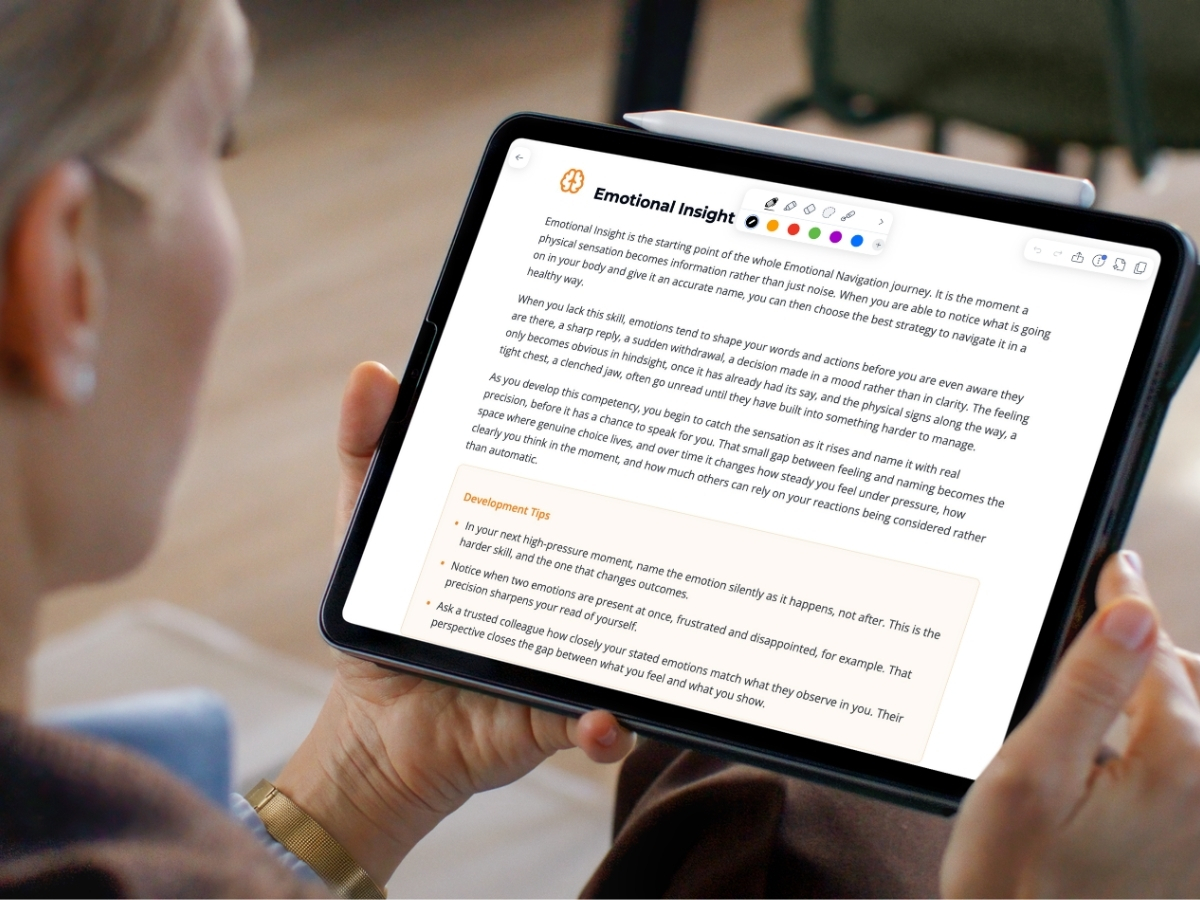
It works through all eighteen competencies and gives you a score and a band for each one, so you can see which of them are quietly carrying you and which ones are costing you something. Sitting above that is your position across the four quadrants, which is often the more interesting view, because it shows whether your pattern lives in how you manage yourself or in how you work with other people.
For every competency there is a description of what it looks like when it is missing, and what begins to change as it develops. That is the part which keeps a low score from being disheartening, because it turns a number into something you can recognise in your own week.
And each one comes with practical steps for developing it, so you finish reading with something to try rather than simply something to feel.
Being clear about what this is not
There is no shortage of free assessments on the internet and most of them are not worth the ten minutes, so it seems only fair to say what this one does and does not do before you begin.
It is not a personality type
You will not be handed a four-letter code or a colour to carry around with you. Competencies are things you can build, which makes them considerably more useful than a category telling you this is simply how you are.
It is not a clinical assessment
The Inventory is a development tool rather than a diagnostic one. It will show you where your capabilities sit and what to do about them, and it is not a substitute for professional support if that is what you are looking for.
It is not twelve questions and a label
There are seventy-two statements, four for every competency, and that is deliberate. With fewer than that the result would be a guess dressed up as a score, which helps nobody.
It is not somebody else’s opinion of you
Every score comes from how you see yourself, which is exactly right for a starting point. It is worth holding lightly though, because sometimes a low score reflects a genuine gap and sometimes it reflects a very high standard.
Ten minutes, start to finish
Three steps, and you can do the whole thing in one sitting.
Tell us where to send it
Your first name, last name and email address, so your report has somewhere to go. You are not asked for card details at any point, because there is nothing to pay.
Answer seventy-two statements
You rate each one from 1 to 10. Go with your first instinct rather than deliberating over it, because the answer you give quickly is usually the more honest one.
Read your Roadmap
Your scores across all eighteen competencies and the four quadrants, with practical development steps for each, ready whenever you are.

Grant Herbert — Founder of People Builders
After working in the field for almost 2 decades as a Master Coach Trainer in Emotional and Social Intelligence, Grant built the Emotional Navigation Roadmap™ to simplify the development of these competencies in the Intelligence Age. The Emotional Navigation Inventory™ is the instrument that he created to bring awareness to people as they embark on this new journey.
The Inventory is complimentary until
Saturday 31 October 2026From the first of November it moves inside the Emotional Navigation Roadmap™ program and will no longer be available on its own. There is nothing waiting to catch you out before then either. No card, no trial to remember to cancel, and nothing on the other side except your report.
Ten minutes now, and you will know which of the eighteen competencies is worth your attention between here and the end of the year.
